
A Riff on Claude Lorrain’s Landscape with Hagar and the Angel, Joachim Koester’s Kant Walks, and Kurt Schwitters’s Merzbarn Wall
(Cf., Alan Liu, Wordsworth: The Sense of History —
Chap. 3, “The Politics of the Picturesque: An Evening Walk“)
|
|
|
|
|
|
|
|
|
|
|
|
|
|
|
|
|
|


In rocky basin its wild waves repose,
Inverted shrubs, and moss of gloomy green,
Cling from the rocks, with pale wood-weeds between;
And its own twilight softens the whole scene,
Save where aloft the subtle sunbeams shine
On withered briars that o’er the crags recline;
Save where, with sparkling foam, a small cascade
Illumines, from within, the leafy shade;
Beyond, along the vista of the brook,
Where antique roots its bustling course o’erlook,
The eye reposes on a secret bridge
Half grey, half shagged with ivy to its ridge; . . .
|
|
|
|
|
|


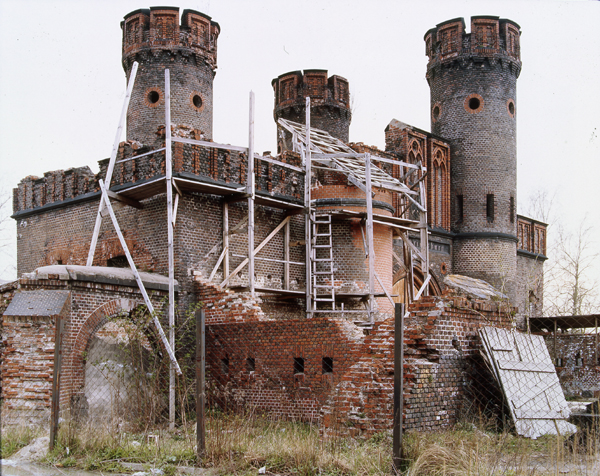 The Kant Walks #1 (Photos taken 2005 in Königsberg/Kalingrad)
C-print, 47,5 x 60,3 cm Framed 68,5 x 80 cm Edition of 5 (+ 2 AP) |
. . . I don’t have any well-shaped thoughts yet about the Kant Walks. But these some hurried, stray thoughts that come to mind:
The images and their making compress together at least three kinds of modern perambulation:
- Kant’s and later Koester’s “circular” strolls are like the circular strolls of “ideology” layered over workaday “mentalities” that Moretti talks about in the maps chapter of his Graphs, Maps, Trees (pp. 38-42). That is, they are the leisurely and reflective strolls of a cultural and intellectual class that walks according to a different idea/ideal of what a walk is for and what one sees on it. In an urban context, we would need to inflect the notion of the “village story” walks that Moretti discusses in the direction of Benjaminian flâneury.
- The workaday walking and other travel patterns (ordinary transportation and transmission channels, as in the power lines in Koester’s photo #7) are nevertheless everywhere in plain sight, even if some of the routes are barred by wire fences.
- Most of the workaday routes and their boundaries can be trespassed by Koester, however, because that is the nature of the junkspace that WW II made. Koester’s walking around in circles that traverse all the ordinary boundaries is thus different from Kant’s original circular walks. The difference is the impress of the war on the urban landscape, which would need to be read in a post-Benjaminian mode as that jumbled pile of things that the angel of history sees in his flight (refugee retreat) backwards.
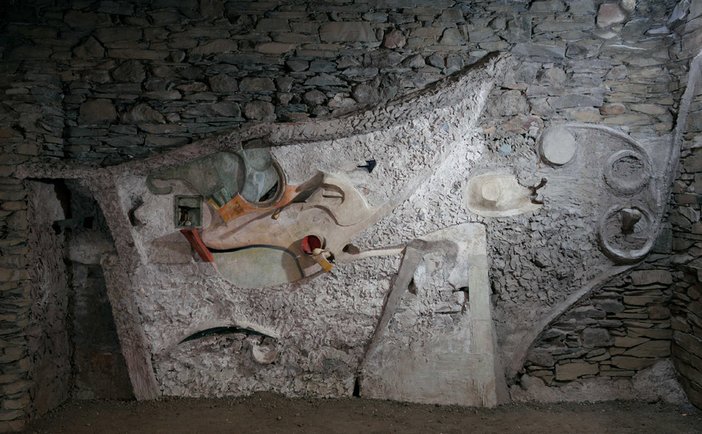
Kurt Schwitters, Merzbarn Wall (1947-48) at the Hatton Gallery (Photograph: Nick May).
|
