
rev. 5 July 2026
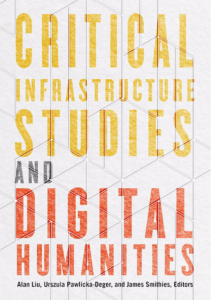
In Critical Infrastructure Studies and Digital Humanities (2026), Alan Liu, Urszula Pawlicka-Deger, and James Smithies position the concept of infrastructure as a distinctive intellectual paradigm well suited to understanding the contemporary world. Building on the tradition of infrastructure studies embodied in Science and Technology Studies (STS), they argue,
critical infrastructure studies today focuses on ‘topics, or difficulties’ reflecting contesting views of what infrastructure is, where it is sited, how it is created and maintained, why it is exists (and breaks down), who it is for (or threatens), and if it is possible to envision better infrastructures–ones more just, caring, and sustainable.
—“Introduction: Object of Study”
This not only helps us think through problems at the heart of the Humanities and Social Sciences (HASS) disciplines, but encourages us to think carefully about the research infrastructures (RI) we are building to support a wide range of disciplines. The implication is that if we begin to view HASS RI as a site for intellectual experimentation, as well as merely organisational investment and practical activity, we have a better chance of responding to the challenges of an era overshadowed by the voracious planetary infrastructure of Artificial Intelligence (AI).
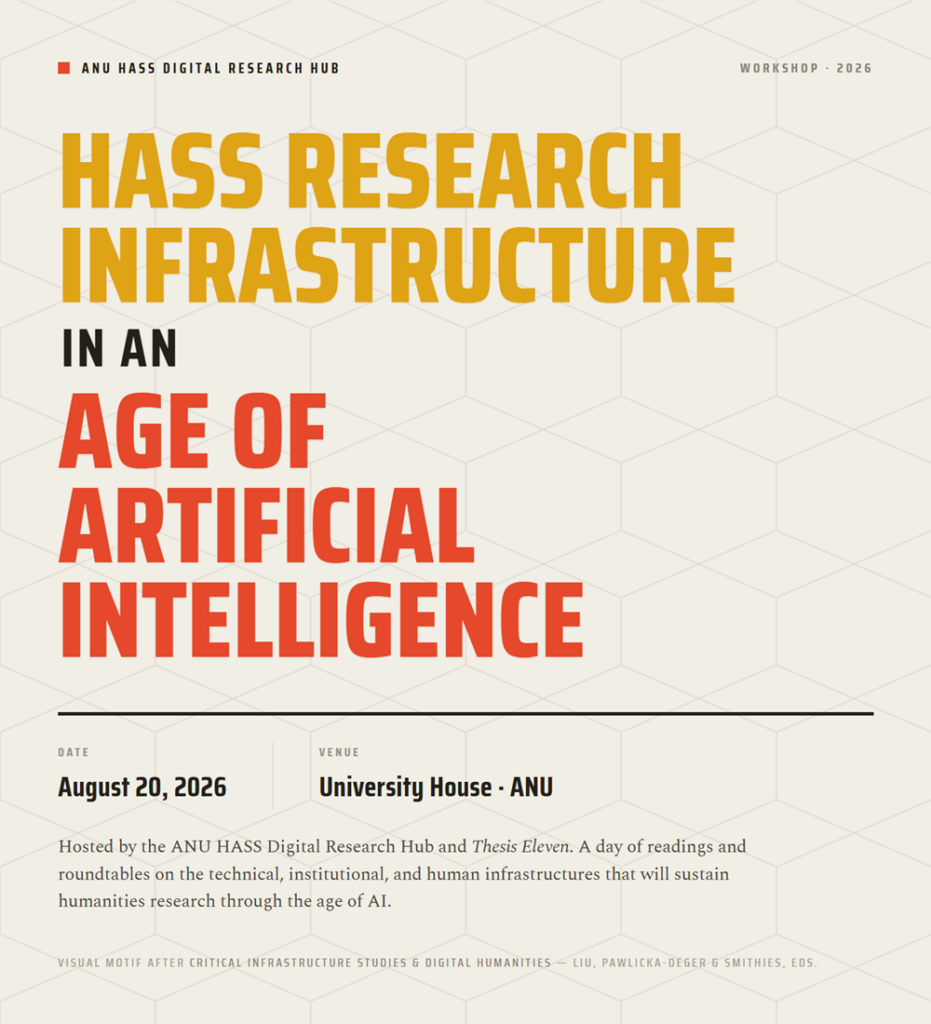
This workshop will launch the book Critical Infrastructure Studies and Digital Humanities and move from there to a panel discussion involving leaders of prominent HASS RI initiatives in Australia, Singapore, and the United States. The workshop will be convened by Craig Calhoun (Arizona State University), framed by an introductory keynote by Alan Liu (UC Santa Barbara), and end with a discussion about possible collaborations with the journal Thesis Eleven that all attendees of the workshop are welcome to contribute to.

9.00 – 9.30
Welcome — Tim Sendon (Pro-Vice Chancellor Research Infrastructure and Entities, ANU)
Introductory Remarks — Craig Calhoun (University Professor of Social Sciences, Arizona State University & Thesis 11 Editorial Board member)
Critical Infrastructure Studies and DH — James Smithies (Professor of Digital Humanities and Director of HASS Digital Research Hub, ANU)
9.30 – 10.00
Keynote: Is Critical Infrastructure Studies of Big AI Possible? (The Critique of AI II) — Alan Liu (University of California, Santa Barbara)
10.00 – 10.30 Morning tea

10.30 – 10.45
The ARDC HASS & Indigenous Research Data Commons — Nichola Burton (Australian Research Data Commons)
10.45 – 11.00
The ANU HASS Digital Research Hub — James Smithies (Australian National University)
11.00 – 11.15
AI, Research Support, and Collaboration: Reflections from the Melbourne Data Analytics Platform (MDAP) — Nic Gerard (University of Melbourne)
11.15 – 11.30
Trove — Jenny Ostini (National Library of Australia)
11.30 – 11.45
Digital HASS at NTU: The Asian Centre for Digital Cultures (ACDC) — Jon Wilson & Li Nguyen (Nanyang Technological University, Singapore)
12.00 – 1.00 Lunch — Panelists + Thesis 11
1.00 – 2.00
Panel Discussion/Close — Panelists
2.00 – 2.30 Afternoon Team — Panelists + Thesis 11
2.30 – 4.00 —Thesis Eleven: Critical Infrastructure Studies (all welcome)
6.00 – 8.00 Dinner
